
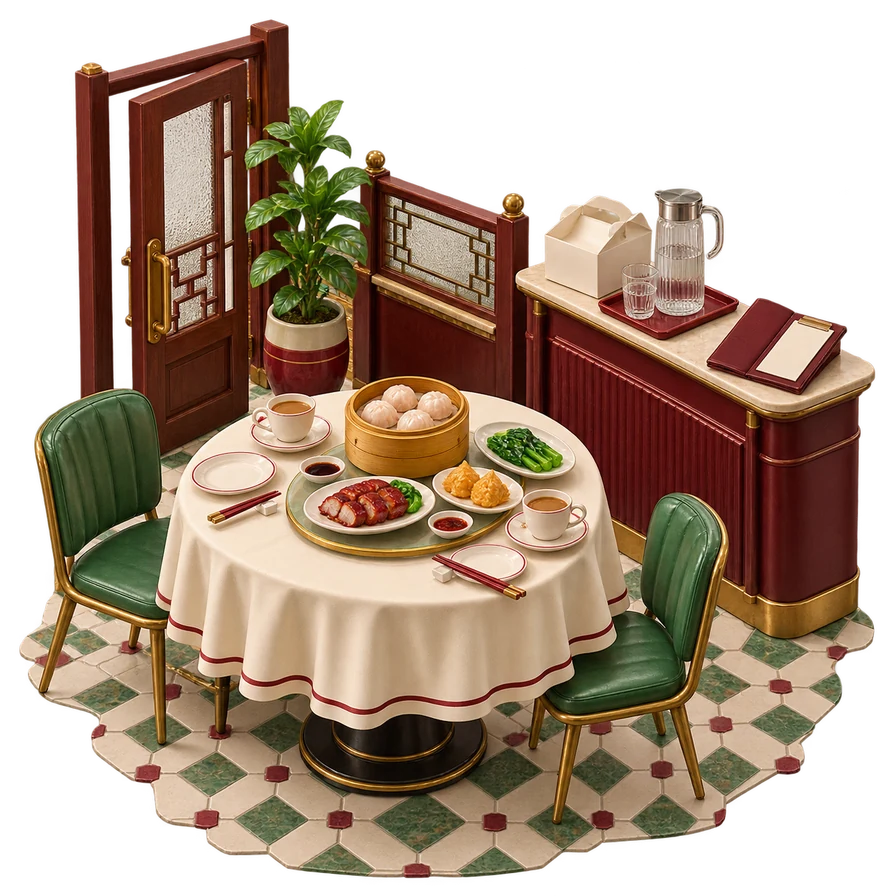
THE SHORT ANSWER
Learn eating-out Cantonese as a sequence: find a place to sit, understand the eat-in or takeaway question, order, check details and pay. Requests such as 唔該加水 and 唔該埋單 are useful at specific moments. A menu, gesture or follow-up question can fill the gaps between phrases.
FOLLOW THE STEPS
A meal is a chain of small exchanges
- Seating可唔可以搭枱呀ho2 m4 ho2 ji5 daap3 toi2 aa3
Ask about sharing where that arrangement is relevant; follow staff guidance.
- Serving choice喺度食定拎走hai2 dou6 sik6 ding6 ling1 zau2
Hear the two options before placing the drink order.
- A precise change走冰zau2 bing1
No ice differs from less ice or less sweetness.
- Payment唔該埋單m4 goi1 maai4 daan1
Ask for the bill, then understand where and how to pay.
Separate a table request from an order
Auntie asks whether sharing a table is possible. That is a request in a relevant situation, not a claim that every Hong Kong restaurant expects strangers to share. Look at the arrangement and follow staff guidance before sitting at an occupied table. For a reservation or a larger group, the number of people and booking details matter more than memorising this one line.
Next, listen for the eat-here or takeaway choice. Identify both options before responding. If you are unsure, point to the seating area or takeaway packaging and confirm, rather than repeating an unfamiliar option at random.
可唔可以搭枱呀
ho2 m4 ho2 ji5 daap3 toi2 aa3
Can we share a table?
喺度食定拎走
hai2 dou6 sik6 ding6 ling1 zau2
Eat here or take it away?
Tap play to hear the saved app recording.
喺度食定拎走?
hai2 dou6 sik6 ding6 ling1 zau2
eat here or take away?
Tap play to hear the saved app recording.
Build one dependable order
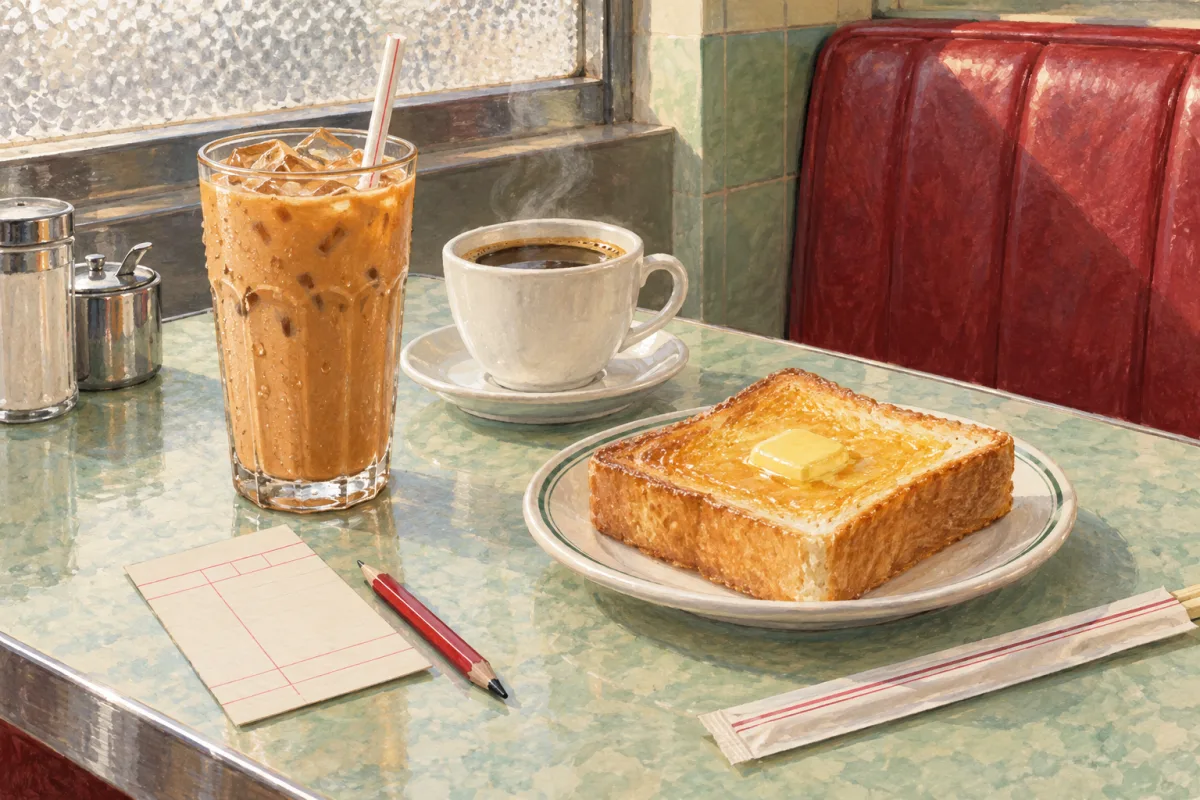
Start with a drink or dish you actually want. The existing milk-tea and hot-coffee recordings provide complete requests you can rehearse. Once you can say one comfortably, change a single item or temperature rather than trying to produce an entire unfamiliar menu. Reading a menu together with staff is a legitimate part of the exchange.
Hong Kong Tourism Board describes cha chaan teng food through its mix of local and Western influences. That cultural background helps explain a varied menu, but it does not tell you the ingredients, prices or availability at the restaurant in front of you. Check that menu.
唔該,我想要一杯凍奶茶
m4 goi1 ngo5 soeng2 jiu3 jat1 bui1 dung3 naai5 caa4
excuse me, I'd like an iced milk tea
Tap play to hear the saved app recording.
我想要一杯熱咖啡
ngo5 soeng2 jiu3 jat1 bui1 jit6 gaa3 fe1
I'd like a hot coffee
Tap play to hear the saved app recording.
A LITTLE PRACTICE
Build one dependable order
Build: “I’d like a hot coffee.”
Tap the chunks in order. Tap a chosen chunk to put it back.
See the model sentence
我想要一杯熱咖啡
ngo5 soeng2 jiu3 jat1 bui1 jit6 gaa3 fe1
The quantity belongs with the drink. Once this request is clear, answer the next staff question instead of repeating it automatically. The English labels gloss whole Cantonese chunks.
Keep changes precise
Less sweet and no ice are different instructions. In the recordings below, 少甜 requests reduced sweetness and 走冰 requests no ice; do not treat the latter as “a little less ice.” Say the modification with the drink, and listen for a confirmation or an explanation that it cannot be changed.
Auntie’s spicy question asks about heat. It is not a complete ingredient check. If a particular ingredient matters to you, ask about that ingredient explicitly and confirm the answer with the venue. A simple spicy/not-spicy exchange cannot establish everything about a dish.
呢個辣唔辣㗎
ni1 go3 laat6 m4 laat6 gaa3
Is this spicy?
Tap play to hear the saved app recording.
Make the immediate request clear
A refill request is short because the water and table are already shared context. Use the same principle for another need: identify the item, then make one request. If something is missing or incorrect, explain which order you mean instead of making a broad complaint about the whole meal.
For leftovers, Auntie asks the staff to pack the food. The line does not establish whether packaging is available, whether a charge applies or what can be packed. Wait for the answer, indicate which dishes you mean, and keep separate containers clear if several people are taking food away.
唔該加水
m4 goi1 gaa1 seoi2
Please refill the water
唔該幫我打包
m4 goi1 bong1 ngo5 daa2 baau1
Please pack this up for me
Ask for the bill and understand the next step
唔該埋單 asks for the bill. It does not specify separate bills or guarantee payment at the table. Staff may direct you to a counter or ask how you want to pay. Check the amount and payment method, then finish the exchange with an appropriate thanks.
Practise the entire sequence once with an uncomplicated order. On a second run, include one interruption: no table available, a drink that cannot be changed, or an item missing from the bill. The aim is to choose a useful next move when the conversation changes.
HEAR THE LINE IN CONTEXT
Watch with Auntie
Can we share a table?
This clip illustrates one expression connected with the topic. The written examples above extend the lesson.
Open the full phrase lesson ↗More lines to explore
For here or takeaway? Is this spicy? Please pack the leftovers Tea refill, please The bill, pleaseRead the Cantonese line
- Cantonese
- 可唔可以搭枱呀
- Jyutping
- ho2 m4 ho2 ji5 daap3 toi2 aa3
- Meaning
- Can we share a table?
TAKE IT WITH YOU
Take it into a conversation
A staff member says 喺度食定拎走 before you order. What are they asking, and what should you establish before naming your drink?
See one possible answer
They are asking whether you will eat there or take the order away. Give or confirm that choice first; then order the drink and attach any precise change such as 少甜.
Keep these in mind
- Learn the meal as a sequence of exchanges.
- Keep sweetness, ice and ingredients as separate questions.
- A request needs a response before you assume the result.