
THE SHORT ANSWER
Use 唔該 (m4 goi1) for practical help, service and many polite requests; 多謝 (do1 ze6) for a gift or an appreciated gesture. 唔好意思 (m4 hou2 ji3 si1) can soften an interruption or acknowledge an inconvenience. 對唔住 (deoi3 m4 zyu6) is a direct apology. Choose the job your sentence needs to do before choosing the English translation.
NOTICE THE DIFFERENCE
What are you doing?
- Practical help唔該m4 goi1
A request or thanks for help.
- A gift多謝do1 ze6
Acknowledge what someone gives or does for you.
- An interruption唔好意思m4 hou2 ji3 si1
Get attention or acknowledge an inconvenience.
- An apology對唔住deoi3 m4 zyu6
Apologise for a mistake.
Four expressions, four useful starting points
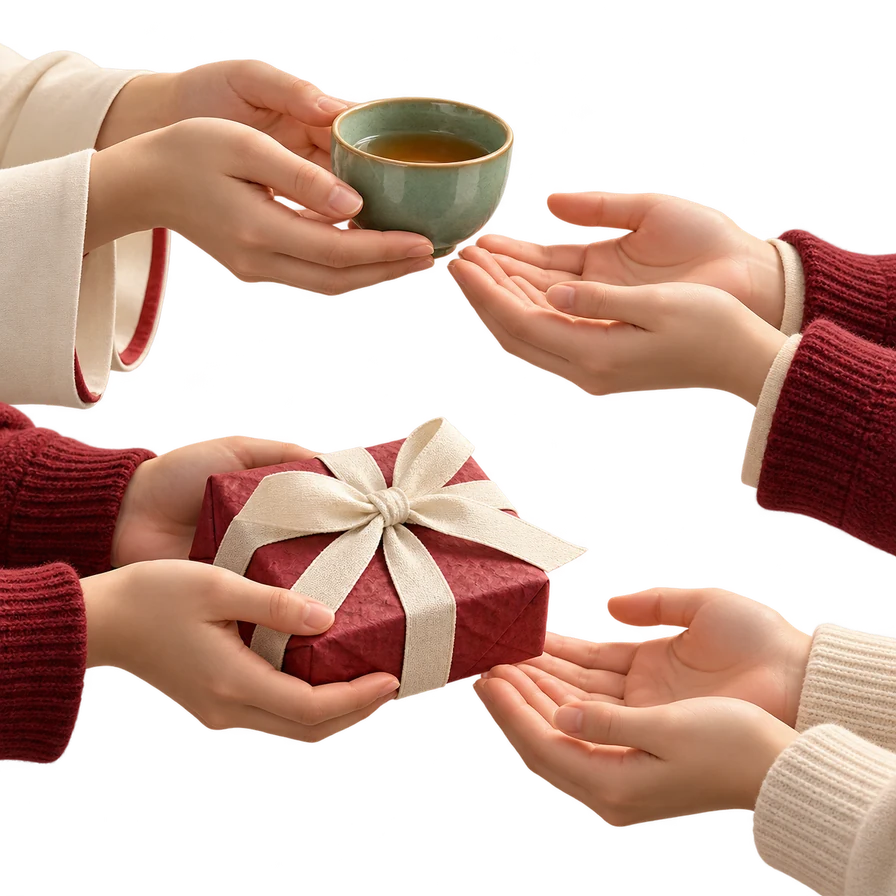
A waiter passes you a cup. 唔該 acknowledges the help. A friend gives you a birthday present. 多謝 acknowledges the gift. These are useful starting points, rather than a rule that every favour must receive exactly one fixed response. What you are appreciating and how you say it both matter.
If you need someone’s attention, 唔該 or 唔好意思 can introduce the request. If you have caused a problem, 對唔住 directly apologises. 唔好意思 also appears in apologies for an inconvenience, so do not imagine a hard boundary that makes one expression impossible in the other situation.
| Situation | Useful starting expression | What it does |
|---|---|---|
| Someone passes you something | 唔該 · m4 goi1 | Thanks for practical help |
| You receive a gift | 多謝 · do1 ze6 | Thanks for the gift |
| You interrupt to ask a question | 唔好意思 · m4 hou2 ji3 si1 | Acknowledges the interruption |
| You apologise for a mistake | 對唔住 · deoi3 m4 zyu6 | Makes a direct apology |
唔該 can come before or after the help
In a request, 唔該 comes before the action you want. After the help, the same short expression can supply the thanks. The surrounding event makes its role clear; you do not need to force the same English word into both positions.
The drink order below begins with 唔該 and then says what the customer wants. The second line asks someone to wait. Listen to the full sentence and notice where the request begins after the polite opening. When you want to thank someone more explicitly for their help, 唔該晒 is another recorded option.
- Before the action: polite opening + the request.
- After the action: a short thanks can stand alone.
- Keep the requested action specific; the courtesy expression cannot supply missing details.
唔該,我想要一杯凍奶茶
m4 goi1 ngo5 soeng2 jiu3 jat1 bui1 dung3 naai5 caa4
excuse me, I'd like an iced milk tea
Tap play to hear the saved app recording.
A LITTLE PRACTICE
Try it
Read the explanation
多謝 · do1 ze6
多謝 is a useful response to receiving a gift.
Match the apology and the reply to what happened
A small accidental bump and a serious mistake need different follow-through. The recorded bump exchange shows an everyday apology followed by reassurance. Its reply means the listener is okay; it is not a word-for-word translation of the apology.
An apology may be only the beginning when something actually needs fixing. Say what happened or explain the next step, and let the other person answer. For a small incident, a brief exchange may be enough. Learn the short apology first without borrowing a dramatic line from an unrelated situation.
“No, thanks” is a refusal, not an apology
When someone offers something you do not need, 唔使喇,唔該 turns it down politely. At a shop, 唔使袋,唔該 says you do not need a bag. Neither means that the other person has done something wrong. The thanks and the refusal are working together.
A useful practice is to keep the setting and change only the action. At the same café, ask for your drink, thank the person who brings it, and decline an extra item you do not need. You are practising three different conversational moves rather than memorising three interchangeable translations.
- Receiving a gift: choose the thanks that recognises it.
- Requesting help: give the action after the polite opening.
- Declining an offer: say that you do not need it, then thank the person.
- After a mistake: apologise and address anything that still needs putting right.
TAKE IT WITH YOU
Take it into a conversation
Choose an expression for each situation: a waiter passes your cup; a friend gives you a gift; you accidentally bump someone; you decline a shopping bag.
See one possible answer
Useful answers are 唔該 (m4 goi1) for the cup, 多謝 (do1 ze6) for the gift, 唔好意思 (m4 hou2 ji3 si1) for the accidental bump, and 唔使袋,唔該 (m4 sai2 doi2 m4 goi1) to decline the bag. These are situation-based choices, not the only sentences a speaker could use.
Keep these in mind
- Choose whether you are requesting, thanking, apologising or declining.
- 唔該 and 多謝 are useful in different thanking situations.
- 唔好意思 and 對唔住 overlap; context and the next action matter.