
THE SHORT ANSWER
For a produce purchase, establish the item, the selling unit and the amount you want before checking the total. 點賣呀 asks how something is priced; it is useful when you do not know whether the sign refers to pieces, a bundle or a weight. Ask about ripeness separately from price.
Ask about the batch in front of you
Choose a visible item and make your question specific. 呢啲橙甜唔甜呀 asks whether these oranges are sweet. The word 呢啲 refers to this group, so the vendor knows which produce you are discussing. The answer concerns the batch as the seller describes it, not every orange sold in Hong Kong.
Keep price and quality questions separate. If you ask about sweetness and then point at a price card, a quick reply may be hard to interpret. First establish the produce, then ask one question. This gives you a clearer listening task and makes a follow-up easier.
呢啲橙甜唔甜呀?
ni1 di1 caang2 tim4 m4 tim4 aa3
Are these oranges sweet?
今日呢批幾甜
gam1 jat6 ni1 pai1 gei2 tim4
Today’s batch is quite sweet
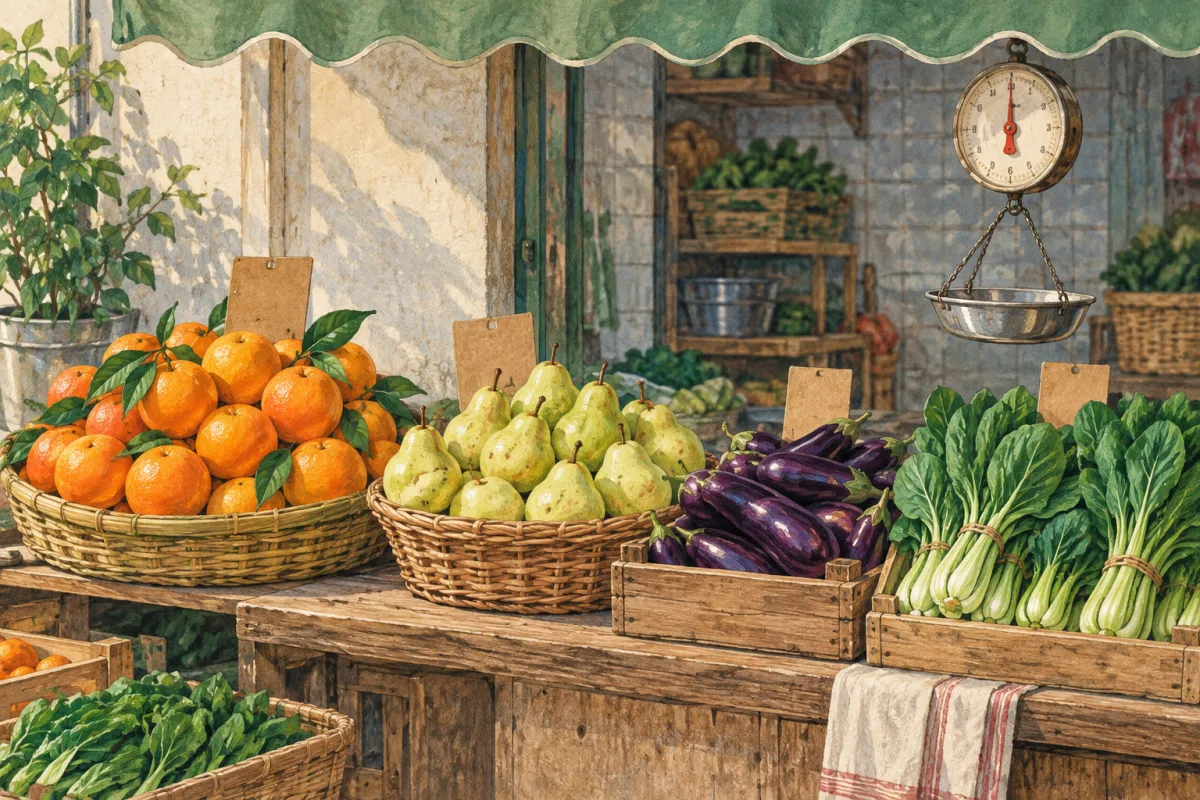
Ask how it is priced before choosing a quantity
點賣呀 asks how the goods are being sold or priced. A reply like 三個二十蚊 gives a bundle: three for twenty dollars. Those are existing practice-phrase figures, not live prices from Graham Street. They show why hearing the number alone is not enough; the number of items belongs to the offer.
Weight is another possibility. The catalogue example 我要半斤菜心 requests half a catty of choy sum. Learn 斤, gan1, as the named unit in that example; do not silently substitute kilograms. If a sign uses a different unit, follow it or ask the seller to clarify. You can choose a preweighed pack when that makes the amount easier to identify.
點賣呀?
dim2 maai6 aa3
how are these priced?
三個二十蚊
saam1 go3 ji6 sap6 man1
three for HK$20
我要半斤菜心
ngo5 jiu3 bun3 gan1 coi3 sam1
I'd like half a catty of choy sum
Say what kind of selection you want
可唔可以揀熟啲㗎 asks for riper ones. It describes a preference rather than diagnosing the produce as good or bad. Make the relevant fruit clear so the vendor knows what to choose. Ripeness, size and quantity are separate decisions; keep the quantity you agreed on visible while discussing selection.
The reply 得,我幫你揀 means the seller will help choose. Listen for that action. It is not a change to the price by itself, and it does not tell you that the produce will be ready on a particular future day. If timing matters for your use, explain it rather than assuming “riper” contains that plan.
可唔可以揀熟啲㗎?
ho2 m4 ho2 ji5 gaan2 suk6 di1 gaa3
Could you pick some riper ones?
得,我幫你揀
dak1 ngo5 bong1 nei5 gaan2
Sure, I’ll choose them for you
Check the total and the bagging request
Once the produce is selected or weighed, confirm the total before paying. If you add two tomatoes, as in 加兩個番茄, the new amount needs to be included. Keeping a small list helps you distinguish an item you asked about from one you actually chose to buy.
唔該幫我分開入袋 asks for separate bagging. Identify which goods should be separated rather than expecting the seller to infer your reason. For a first practice visit, one genuine purchase is enough: ask a useful question, understand the unit, request a manageable amount and close the transaction. Use the official destination information to plan access rather than treating this language exercise as a live route or timetable.
加兩個番茄
gaa1 loeng5 go3 faan1 ke2
Add two tomatoes
唔該幫我分開入袋
m4 goi1 bong1 ngo5 fan1 hoi1 jap6 doi2
Please bag these separately
YOUR TURN
Try it yourself
You hear 三個二十蚊. Does 二十蚊 tell you the price of one item here?
See one possible answer
The complete phrase says three for HK$20. Keep the bundle quantity with the price. If you want a different quantity, ask rather than assuming the same per-item arrangement.
Keep these in mind
- Listen for the unit as well as the amount.
- Ask about sweetness or ripeness separately from price.
- The example prices are practice figures, not current market offers.